THE LETTER THAT TURNED MY LIFE UPSIDE DOWN ONE DAY BEFORE MY WEDDING
A Visit That Was Supposed to Bring Closure
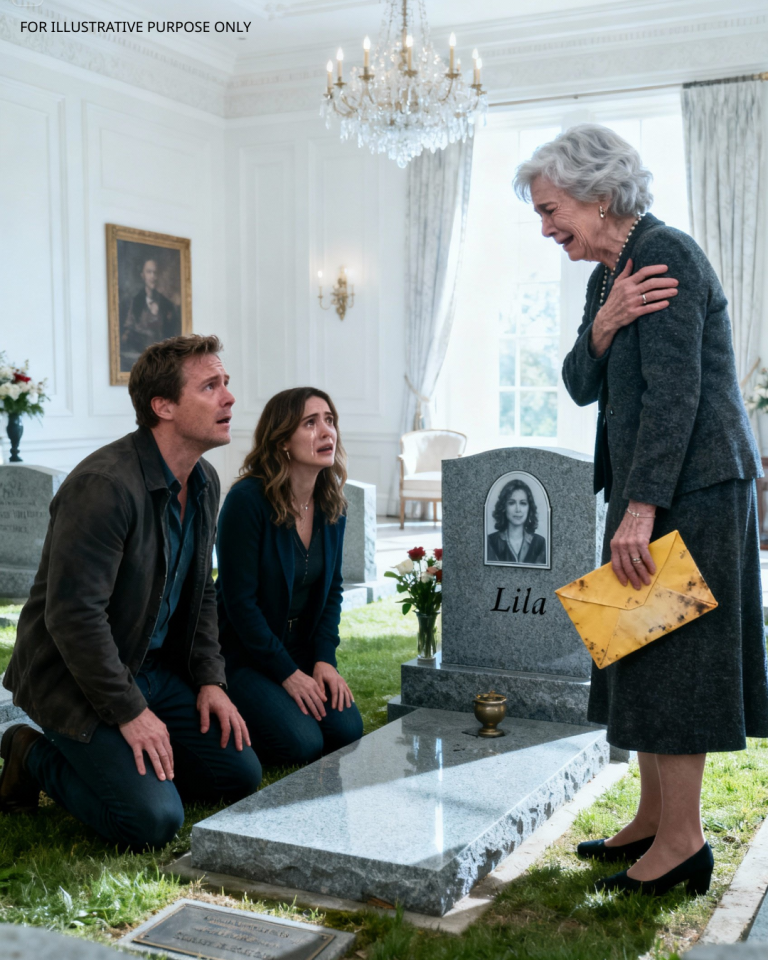
The day before my wedding, I drove to Willow Springs Cemetery expecting peace, not disruption. The sky had that soft gray tone that always made the whole town feel quieter. I had carried a bouquet of white peonies—Lila’s favorite—hoping to leave them at her grave before stepping into a new chapter of my life.
Lila had passed three years earlier, and although grief had lost its sharp edges, it still lived somewhere inside me. Visiting her before my wedding felt like the respectful thing to do. She had been a significant part of my story, and I didn’t want to pretend she never existed.
But as soon as I approached her headstone, I noticed someone standing there.
A thin woman, bundled in a long navy coat, her shoulders slightly hunched as if weighed down by an invisible force. She held a weathered brown envelope in her hands. When she heard me step on the gravel, she turned slowly.
Her eyes—soft, tired, watery—met mine.
“You must be Mason Ellerby,” she whispered.
I froze.
She knew my name.
She stepped closer, and in a trembling voice said something I didn’t expect in a million years:
“I’m… Miriam. Lila’s mother.”
Everything inside me stopped.
Lila had always told me her parents passed away during her childhood. She avoided talking about her past, and I never pushed. I believed her without hesitation.
But here stood a woman who looked heartbreakingly real—alive, breathing, staring straight at me with a mixture of guilt and hope.
“I know this is a shock,” she said gently. “But my daughter wanted you to have this.”
She held out the envelope with both hands. I could see the faint outline of Lila’s handwriting where my name was written across the front.
My breath caught.
“Why now?” I asked.
“Because you’re getting married,” she said softly. “And she wanted you to know the truth before you build a new life. She didn’t want her story to follow you like a shadow.”
My knees felt weak. I took the envelope, and the air around us suddenly felt heavier.
The Photograph and the Letter
I opened the envelope carefully, afraid it might crumble in my hands after so many years.
Inside were two things:
A folded letter.
And a photograph that made my stomach flip.
The photo showed Lila at around eighteen or nineteen— younger, but unmistakably herself. She stood outside a large farmhouse, beside a man maybe twice her age. The smile on her face looked forced, stiff. Behind them were other people—adults, children, a full bustling family she had never once mentioned.
The farmhouse in the background matched the vague descriptions Lila had shared about “the place she grew up.” But she had always framed her childhood as quiet and lonely.
This picture showed the opposite.
I looked up at Miriam, who was wiping her eyes.
“She ran away before she turned nineteen,” Miriam whispered. “She rebuilt her identity from scratch. She hid everything… even from you.”
My heart pounded as I opened the letter.
It began the way Lila always spoke when she was afraid to hurt me:
“Mason, if you’re reading this, it means Mom found you. I’m sorry for everything I couldn’t say.”
She explained that she had left home at nineteen to escape a household full of emotional confusion—one dominated by Rowan Price, the man in the photo. Rowan had been her mother’s husband for many years, someone influential in their town, someone whose presence made every room tenser.
Lila wrote about long years of feeling unheard, of trying to express that something was wrong in their home environment but being dismissed by relatives, neighbors, even friends. Her words weren’t graphic; they didn’t need to be. They carried the weight of a person who had felt unsafe for far too long.
When she told the truth to her mother, the household divided. Some relatives believed her. Others insisted she was misinterpreting things or trying to cause disruption. Rowan denied everything. And because he was highly respected, his word overshadowed hers.
So she left.
She changed her last name.
She moved states.
She erased everything behind her.
She wrote:
“I told myself no one would ever believe me again. I carried that fear into every relationship, even with you.”
My chest tightened.
I remembered nights when Lila woke up startled. Days when she avoided talking about her childhood. Times when she pulled her hand away if someone walked behind her too quickly.
Back then, I hadn’t understood. Now I did.
But the letter revealed something far more urgent:
“Mason… Mom is not safe. Rowan never stopped looking for her after I left. If she finds you one day, please help her.”
I stared at the page, speechless.
This wasn’t just a confession.
It was a warning.
The Present Danger
Miriam and I sat on a stone bench near the grave.
She told me everything the letter didn’t cover.
After Lila left home, Rowan had become obsessed with controlling the narrative. He insisted she had spread lies, told relatives she was unstable, and tried to discredit anyone who supported her.
When Lila passed away in a car accident years later, Miriam discovered a brief mention in an online obituary. She didn’t attend the funeral openly because Rowan was still monitoring her movements. Instead, she stayed hidden in the distance and watched me grieve.
“I saw how much you loved her,” she said quietly. “And I knew you were the one person she trusted deeply. I also knew she left something behind for you. It took me three years to gather enough courage to find you.”
Her hands trembled.
“And now I think Rowan has found me again.”
My entire body tensed.
She explained that for several weeks she noticed unfamiliar cars near her apartment. Footsteps outside her door at odd hours. Someone leaving notes that made her skin crawl. Nothing directly threatening—but enough to make her relive every moment she had spent years trying to forget.
“And then,” she whispered, “I saw your engagement announcement online. I realized I couldn’t wait anymore.”
She had come straight to the cemetery that morning in hopes of finding me there. If she had missed me, she didn’t know what she would have done.
I knew instantly I couldn’t leave her alone. Not now. Not ever.
“Come with me,” I said. “I’ll take you somewhere safe.”
Bringing Miriam Home
I drove Miriam to my house, where my fiancée, Tessa Calder, was arranging wedding details. Tessa was calm, analytical, and the kind of person who faced a crisis by immediately making a plan.
When I walked in with Miriam, Tessa saw the tension on my face and didn’t waste a second asking the wrong questions.
“Who is she?” she asked quietly.
“Miriam,” I said. “Lila’s mother.”
A small pause.
A soft inhale.
Then Tessa reached out her hand to Miriam.
“I’m glad you’re here,” she said gently. “We’ll help you.”
We sat together in the living room as Miriam explained the situation. Instead of reacting with jealousy or suspicion, Tessa listened with absolute composure.
I will never forget what she told me later that night:
“If Lila trusted you to protect her mother, then I trust her too. This isn’t about the past. This is about keeping someone safe right now.”
Her words steadied me more than she knew.
We prepared the guest room for Miriam. Tessa went through legal paperwork she had saved from previous cases to figure out which steps we needed to take if Rowan really was tracking her. I changed every security setting in the house, locked windows, reinforced doors, and checked the backyard twice.
Around midnight, the motion-activated camera near the driveway sent an alert to my phone.
A figure was standing in the yard.
Still. Silent. Watching the house.
Even through the grainy camera feed, I recognized him from the photograph.
Rowan Price.
I felt a surge of heat crawl up my spine.
Not violence. Not rage.
Just a deep determination to keep the people in my house safe.
Tessa called the police with her usual clear, firm voice. I stood near Miriam, who was visibly shaking, and stayed beside her until officers arrived. Rowan tried to walk away when he saw the police cars pull up, but they stopped him and identified him. Tessa handed them the documentation related to a previous restraining order Miriam had filed years earlier.
It was enough for them to step in.
Rowan was escorted away that night.
And for the first time in years, Miriam exhaled without fear.
The Wedding Day
The next morning, I woke up feeling like I’d lived a lifetime within twelve hours.
Tessa and I talked quietly in the kitchen. She held my hands across the counter.
“Do you still want to get married today?” she asked gently.
I nodded.
“It feels even clearer now,” I said. “I want our life to start with honesty, with strength, with everything we faced yesterday—not despite it.”
Tessa gave me a soft smile.
“Then let’s do it.”
Before the ceremony began, I asked our guests for a moment of silence—not to reopen wounds, but to honor the person who had changed my life in ways both beautiful and complicated.
“I wouldn’t be the man I am today without the years I shared with Lila,” I said. “She taught me compassion, patience, and courage. Today, I honor her by choosing a life filled with those values.”
Tessa squeezed my hand.
Miriam wiped tears discreetly from the back row.
And then the ceremony continued—gentle, heartfelt, steady.

A New Beginning With Room for the Past
In the months that followed, Miriam became part of our family. She moved into a small apartment just a few blocks from us, where she felt safe. Tessa helped her navigate legal paperwork. I helped her assemble furniture, set up cameras, install alarms. She joined us for dinner every Sunday.
It wasn’t just about protecting her.
It was about giving her the sense of security she had been denied for so long.
Rowan’s influence slowly faded over time. With legal measures in place, he could no longer approach Miriam. And for the first time in decades, she finally slept without fear.
Tessa and I welcomed a baby girl a year later. We named her Holland, not after anyone, just because the name felt hopeful and bright—two things we wanted for her.
As Holland grew, Miriam adored her. She would sit with her in the living room singing gentle songs, telling her stories about kindness, strength, and starting over.
And sometimes, quietly, she’d tell me stories about Lila too—about her laugh, her hopes, her dreams. Not the fear. Just the pieces of her daughter she wanted the world to remember.
Visiting Lila Again
Two years after that night, I visited Lila’s grave again. This time, I didn’t feel the weight of guilt. I felt gratitude.
I placed a small bouquet of peonies on the grass.
“Your letter saved your mother,” I whispered. “And it reminded me how important it is to protect the people we love.”
I told her about Tessa, about Holland, about how Miriam was finally safe. I told her how her courage—leaving, rebuilding, surviving—had shaped the way I lived my life now.
Before I walked away, I said the words I had carried in me for years:
“You didn’t break me, Lila. You made me better. And I hope somewhere, somehow, you feel the peace you always deserved.”
What I Carry Forward
Life didn’t go the way I expected.
It went better.
Not easier.
Not lighter.
But deeper.
Because now I understood:
-
Some people leave us, but their lessons stay.
-
Some stories hurt, but they teach us to protect better.
-
And some truths, no matter how heavy, end up freeing everyone involved.
Lila’s final gift was not sadness—it was direction.
And every day with Tessa, Holland, and Miriam reminds me of this:
Love is not just about being happy together.
Love is about being safe together.
Being brave together.
Being whole together.
And that’s exactly the life I’m living now.