The Christmas Eve That Changed Everything
On Christmas Eve, I thought my life was finally settling into something warm and steady. I was twenty-six, working long shifts as a forklift operator at a big distribution center on the edge of Cleveland, Ohio. The pay wasn’t amazing, but my bills were covered, my car ran, and most nights I ended up at my parents’ house for dinner. It was simple, and I thought simple meant safe.
That night, the whole family had crowded into my parents’ small but cozy house. The kitchen smelled like roasted turkey and cinnamon. My mom, Elena Mercer, moved back and forth between the stove and the table, humming old Christmas songs while she checked every dish twice. My dad, Howard Mercer, owner of a small towing and repair company, sat at the head of the table with his usual serious face, saying very little but making everyone anxious without even trying.
Everyone was waiting for my older brother, Caleb, to arrive. He was the family star—the police officer with the pressed uniform and the stories people loved to hear. My mom kept glancing at the door and whispering to me, “This is the first year we’ve all made it. It’s going to be perfect, Logan.” I believed her. I wanted to believe her.
Then the sirens started.
At first I thought they were just passing down the main road. But they grew louder and louder until blue and red lights flashed right through the front windows. My aunt laughed and said, “That must be Caleb showing off again.” Everyone clapped, expecting him to walk in with a big grin and a few coworkers carrying bottles of wine.
Instead, we watched a patrol car stop hard in front of the house. Caleb stepped out in full uniform, his face like stone. Three other officers followed behind him.
When he pushed the front door open, no one was clapping anymore.
He didn’t hug Mom. He didn’t smile at Dad. He scanned the room, locked his eyes on me, and said in a flat voice, “I received a tip that Logan is keeping illegal packages in his car. I need to check it out.”
The room went silent. My mom gripped my hand so hard it hurt. I laughed for a second, thinking it had to be some kind of messed-up joke.
“Caleb, what are you talking about?” I asked. “You know me.”
But he didn’t blink. “Logan, come outside so we can search the car and your jacket. If it’s nothing, this is over.”
Neighbors had already stepped out into the snow. My relatives crowded onto the front lawn as the officers opened my trunk. One of them held up small sealed packets that glittered under the flashlight, then reached into my jacket pockets and pulled out more.
My mom started crying. My dad just stood there with his arms crossed, jaw clenched, saying nothing. I kept repeating, “That’s not mine. I don’t know where that came from,” but my voice sounded small even to my own ears.
Caleb’s face didn’t change. He read me my rights in front of the people who had watched me grow up. Cold metal closed around my wrists. The last thing I saw before the car door slammed was my mother sinking to her knees in the snow while my father told her to be quiet and “let the law do its job.”
The Longest Night of My Life
The ride to the station felt like falling down a dark well. I stared out at the snow-covered streets of the city I thought I understood, wondering how everything could twist in a single hour.
The holding cell was small, cold, and smelled like metal and old sweat. They took my shoelaces and my belt and left me with a paper-thin blanket and my racing thoughts. I didn’t sleep. I just lay there, listening to distant shouts and the hum of fluorescent lights, replaying every moment of the evening, searching for some detail that would make sense.
The next morning, they dragged me into an interrogation room. Two detectives sat across from me with a camera running and the packets lined up on the table like silent accusations. They read my information in flat voices, then started firing questions.
“Who gave this to you?”
“How long have you been holding product?”
“Who are you working with?”
I told them over and over that I had never seen those packets before, that someone must have put them in my car and into my pockets. They looked at each other and smirked, like they had heard the same line a thousand times.
Then the door opened and Caleb walked in.
For a second, I felt hope. This was my big brother, the one who used to walk me to school, the one who taught me how to drive in Dad’s old truck. I looked at him and said, “You know I didn’t do this. Tell them.”
He didn’t come to my side. He stood behind the detectives, arms crossed. “Logan, the evidence doesn’t lie,” he said quietly. “If you cooperate and admit what you did, things will go easier.”
I stared at him like I didn’t recognize him. “You’re my brother,” I whispered. “You’re supposed to believe me.”
He held my gaze for a moment, then looked away and left the room.
They assigned me a young public defender with tired eyes and a folder full of cases. He told me we could try to challenge the tip and suggest that someone had planted the packets, but even he sounded like he didn’t believe that would be enough.
When my parents came to see me through the glass, my mom pressed a shaking hand to the partition and cried, “I know you, Logan. I know you didn’t do this. I’ll find someone to help.”
My dad took the phone and cut her off. “You’ve always been soft,” he said. “You need to accept what you’ve done and take responsibility so we don’t all go down with you.”
I sat there staring at my own father as if he were a stranger. In a way, he already was.
The Courtroom and the Man From the Park
A week later, they brought me to court. Cameras flashed as I stepped out of the van in handcuffs. Reporters called my name, shouting questions about the “officer’s brother” taken in on Christmas Eve. I kept my head down, cheeks burning.
Inside, the courtroom smelled like polished wood and perfume. The judge sat high above, looking down at me as if he was already weighing my future in his hands. The prosecutor—a sharp woman with a voice like a knife—put photos of the packets on a large screen and read Caleb’s report word for word. Every officer who had been there that night testified. Their stories matched perfectly.
My lawyer tried to raise doubts about the anonymous call and suggested someone could have set me up. The prosecutor quickly shut him down. “He was found with a large amount of these substances in his own car and jacket,” she said. “That speaks for itself.”
My father sat in the front row beside Caleb, talking quietly with him, their expressions unreadable. My mother cried silently, twisting a tissue in her hands.
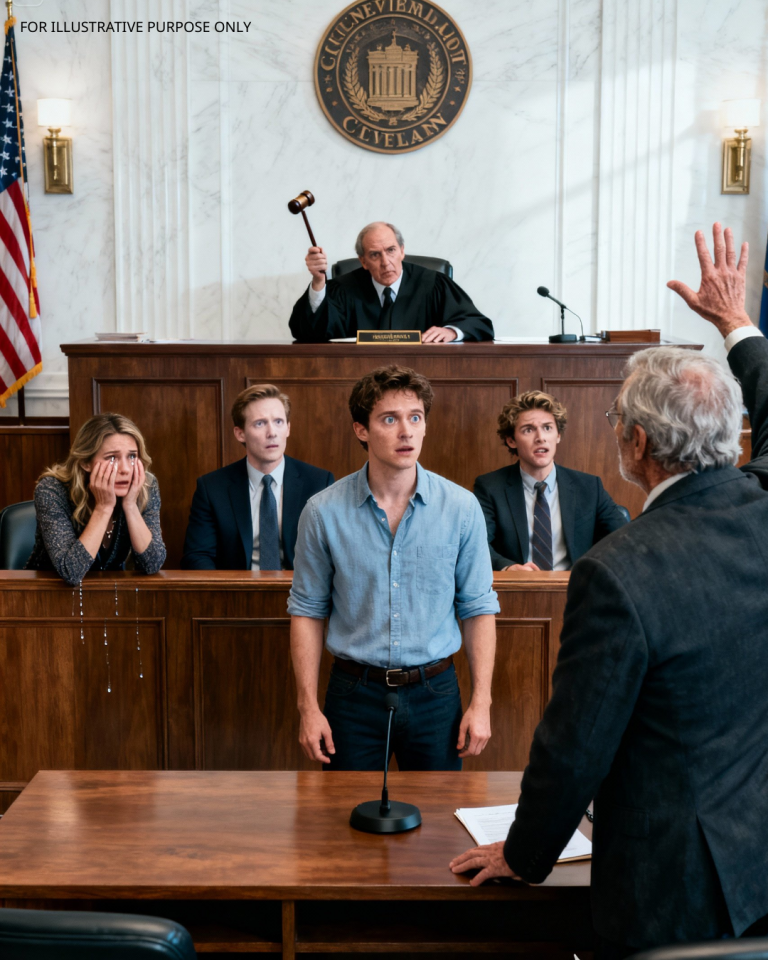
On the day scheduled for sentencing, the courtroom was packed from wall to wall. I sat at the defense table in a gray jumpsuit, hands trembling. The judge lifted his gavel. My stomach clenched so hard I could barely breathe.
Then a rough voice called out from the back, loud and clear.
“Your Honor, wait. I have proof that this man is innocent.”
Every head turned. I did too.
Standing at the very back was the older unhoused man I had seen for months in a small park near my apartment. I had brought him coffee on cold mornings, bought him sandwiches, sometimes sat with him when I was too tired to go straight home after work. We talked about life, about how heavy things could feel sometimes, and he always tried to encourage me.
Now he stood there, beard shaking, worn coat hanging off his thin shoulders, eyes burning with determination.
Caleb jumped up immediately, badge flashing. “He’s disrupting the court,” he barked. “Officers, remove him.”
Two guards moved toward the back row, hands outstretched. The judge pounded his gavel, shouting for order. The room buzzed with confusion.
The man held up a hand. “If you drag me out before I speak, you’ll be helping the wrong people,” he said. His voice was suddenly calm, almost steady.
Then, under the bright courtroom lights, he did something that made the whole place go silent.
He pulled off his fake beard. He shrugged out of the old coat. He wiped his face with a handkerchief. Gray powder and dirt came away, and underneath appeared a man in his fifties with short hair, clear eyes, and a face I recognized from photos in our hallway.
It was my uncle, Owen Mercer—my dad’s younger brother. Three years earlier, he had disappeared during a work trip. Everyone said it had been some kind of accident. We had held a small memorial when they never found his body.
Now he stood alive in the middle of the courtroom, very real and very certain.
My father’s face drained of color. Caleb dropped back into his seat like someone had pulled the ground from under him.
I couldn’t stop the tears. “Uncle Owen?” I whispered, my voice cracking.
The Truth Behind the Disguise
After a quick identity check, the judge allowed my uncle to speak. Owen walked to the witness stand with an old leather briefcase in his hand. Inside were documents, a small hard drive, and a USB stick.
He started with a simple sentence. “Three years ago, I was working as a private investigator on a large case here in Ohio,” he said. “What I discovered led me to my own brother and my nephew.”
He explained how, during that investigation, he had followed financial records and late-night movements that pointed straight at my father’s towing business and Caleb’s role as an officer. According to him, they were part of a hidden network moving forbidden goods through the city, using the garage to hide shipments and uniforms to misdirect attention.
“I planned to take everything I had to federal agents,” he said. “But before I could, Howard found out what I knew.” His voice tightened. “He decided I was a risk.”
Owen told the court how he had overheard my father talking about getting rid of him permanently. Afraid not only for himself but for his wife and daughter, he had staged his disappearance, placed his family under protection in another state, and come back to Cleveland under a disguise.
“People look past someone who seems to live on the street,” he said quietly. “It was the only way I could stay close enough to keep watching—and to protect the one person I knew they might sacrifice if things went wrong.”
He looked straight at me then, eyes soft with sadness.
He plugged the USB into a computer. On the big screen behind the judge, grainy video appeared. It was the side of our house, the driveway, my old car. The date in the corner was the night before Christmas Eve.
We all watched as Caleb walked into the frame, glancing around. He opened my trunk, pulled a small box from his jacket, and tucked packets inside. Then he stepped into the garage, reached into my jacket hanging on a hook, and slid more packets into the pockets.
My brother’s movements were careful, practiced. There was no hesitation.
My mother covered her mouth with both hands. A soft cry escaped her. My father muttered that the video was fake, that someone had edited it, but even the prosecutor looked shaken.
Then Owen played an audio file captured from a bug he had hidden in my father’s office. My father’s voice came first, low and steady.
“If someone has to take the fall, it’ll be Logan,” he said. “He won’t fight. He never does.”
Then Caleb’s voice answered, tired but agreeing. “One anonymous call is all it will take.”
The whole room seemed to stop breathing. I felt like all the air had been sucked out of my chest. Hearing my own father call me easy to sacrifice hurt more than any cell, more than any accusation.
Owen laid out more evidence: bank statements, false invoices, reports he had quietly shared with federal agents. He explained that he had waited for this exact moment—my sentencing—because he knew the courtroom would be full of reporters, lawyers, and officials, making it much harder for my father and brother to silence him or twist the story.
The prosecutor, who had been ready to argue for a long sentence, stood and asked the judge to stop the proceedings, drop the charges against me for now, and place my father and brother in custody while the new evidence was examined.
The judge agreed.
My cuffs were removed in front of the entire room. Officers walked past me to where my father and brother sat. My father cursed at Owen and swore everyone was against him. Caleb kept his head down, saying nothing as they led him away.
My mother rushed forward, wrapping her arms around me and sobbing into my shoulder. I clung to her like a drowning person. Owen came over and rested a hand on my back.
“It’s over, Logan,” he said softly. “You’re free.”
A Hidden Gift and a New Beginning
The next morning, after federal agents checked Owen’s files and confirmed everything, the charges against me were dropped. The case against my father and brother moved forward instead. For the first time in days, I stepped outside without handcuffs, feeling the cold air on my face like something brand new.
Outside the station, Owen was waiting for me. He looked older than I remembered, but his eyes were gentle. I hugged him so tightly it hurt.
“You saved my life,” I said into his shoulder.
He shook his head. “You saved mine, too, kid. You kept me human when I was out there pretending to be someone else.”
We went back to my parents’ house with my mom. The Christmas decorations were still up, but everything felt different. The lights seemed dimmer. The table looked smaller without my father at the head.
We sat in the living room, and Owen pulled out the same worn briefcase. This time, he set a thick envelope on the coffee table.
“There’s something I’ve been holding for you,” he said. “From your grandfather.”
My grandfather, Franklin Mercer, had passed away five years earlier. He had been a quiet man who lived in a small house near the edge of town, spending his days tending a vegetable garden and reading the financial section of the newspaper. I had always felt close to him. His place had been my refuge when my father’s words got too sharp.
The envelope contained documents and a letter written in his careful handwriting. Before he died, he had created a trust in my name and asked Owen to manage it in secret until “the day Logan is pushed to the very edge and needs a way to start over.”
I stared at the numbers, struggling to understand. Years of patient investing had turned into a fund worth more than I had ever imagined—money in savings, stock, and a piece of commercial property outside the city. At the end of the packet was the letter.
In it, my grandfather told me he had seen my heart clearly since I was a boy. He wrote that I was not weak, just soft-spoken, and that my kindness was the strongest thing about me. He said he believed I would one day help the family in a way no one else could, and that this fund was his way of standing beside me even after he was gone.
By the time I finished reading, my vision was blurred with tears. For so long, I had felt like the spare, the one who didn’t shine. Now I knew at least one person had seen me differently all along.
With Owen’s help, I used part of the trust to move my mother out of the house filled with painful memories and into a quieter place outside the city—big windows, a small garden, sunlight in every room. She cried when she saw it, not from sadness this time, but from relief.
“I didn’t think I would ever feel safe in a home again,” she whispered.

Turning Pain Into Purpose
In the months that followed, the story of our family was everywhere. News stations covered the trial of my father and brother, replaying the video and audio that had almost buried me. Reporters tried to chase me down for comments, but I kept my head low and focused on breathing normally again.
Owen and I talked late into many nights. He told me about the years he had spent hiding, the near misses, the times he had almost given up. I told him about the cell, the cold, and the sound of my own father’s voice telling me I wasn’t worth fighting for.
Out of those quiet conversations, an idea grew. With part of the trust, we opened a small investigation and security agency in downtown Cleveland. We hired a couple of young investigators, bought equipment, and painted our names on the glass door: Mercer & Owen Investigations.
At first our cases were small—background checks, missing receipts, neighborhood disputes. Then word started to spread. People who had been blamed unfairly or pushed aside found their way to us. A teenager whose locker had been used to hide contraband. A single father accused of something he hadn’t done. A shop owner framed by a competitor.
Every time we helped someone prove the truth, something inside me healed a little more. I knew what it felt like to sit in a cell and believe nobody would ever listen. Now I got to be the person who said, “I believe you. Let’s see what we can find.”
The work was heavy sometimes, but it gave meaning to the darkest part of my past. I was no longer just the man who had been set up. I was someone who could stand between others and that same pain.
With more of the fund, I helped Owen bring his wife and daughter back from hiding. Watching them walk toward him at the airport, running into his arms after three long years, made my throat tighten. My mother cried quietly beside me, clutching my hand.
Slowly, we began to feel like a family again—different, smaller, but gentler.
Facing the Past One Last Time
Even as life grew steadier, one weight remained. I couldn’t stop thinking about my father and my brother sitting in their cells. I didn’t miss their choices, but I remembered moments before everything went wrong: my dad teaching me how to change a tire, Caleb showing me how to throw a baseball in the backyard. Those memories sat beside the newer, sharper ones, and my heart didn’t know what to do with both.
One day, I realized I had to see them. Not to fix what they had done, but to close the door in a way that didn’t leave me trapped inside.
My mom agreed to come with me. The prison was gray and quiet, its fences crowned with wire. We passed through metal detectors and heavy doors until we reached a small visitation room with a thick glass window and plastic phones on each side.
My father came in first, thinner than before but still carrying that hard stare. He picked up the phone and asked, “So, you came to enjoy the view?” as if we were sharing a joke.
I didn’t feel angry the way I thought I would. I mostly felt tired.
Caleb sat down beside him. His shoulders were slumped, his eyes red and older than they should be.
For a moment, none of us spoke. Finally, Caleb looked up and said, “Logan, I’m sorry. I can’t take it back, but I am sorry. I let Dad push me, and I didn’t stop it. I should have.”
My father snorted and shook his head. “You were always too soft to survive out here,” he said. “If you had been stronger, this would have gone differently.”
I stared at the man who had raised me and realized he still didn’t see me, not really. Maybe he never had.
I spoke slowly, choosing each word. “Dad, I’m not here to argue with you,” I said. “You made your choices. You live with them now.”
Then I turned to my brother. His eyes were full of regret.
“I forgive you,” I told him. “But I can’t keep you in my life. I need to move on.”
Tears slid down Caleb’s face. He nodded, as if he understood that this was both a gift and a boundary.
When Mom and I walked back out into the fresh air, I felt lighter, as if I had set down a suitcase I’d been carrying for far too long.
The Family I Chose
Time moved forward. Our agency grew. We started a small foundation to help people caught in unfair situations get legal aid and emotional support. My mom planted flowers in her new backyard and joined a group at the community center. Owen rebuilt his life with his family.
At a community event about second chances, I met Lauren Grant, a social worker who spoke with calm strength about helping people rebuild after mistakes and losses. She had a warm laugh and eyes that seemed to really listen when you talked. We started meeting for coffee, then walks, then dinners.
She didn’t look at me like a headline. She looked at me like a person who had walked through fire and was still standing. I fell in love with her gentleness and her quiet courage.
We got married in a small ceremony in our backyard on a soft summer evening. My mom cried happy tears. Owen walked me to the front. Lauren’s friends filled the air with laughter and music. There was no fancy venue, no huge guest list—just people who had chosen to stay.
A year later, we had a daughter and named her Frankie, after my grandfather. The first time I held her, tiny and warm against my chest, I promised quietly, “You will never doubt that you are loved. Not for a single day.”
Our house filled with new sounds: baby giggles, toys rolling across hardwood, my mom singing softly in the kitchen while Frankie reached for her. On weekends, Owen and his family came over for dinner, and the living room glowed with conversation and clinking dishes.
One snowy December night, we all gathered around the tree—Lauren beside me, Frankie asleep on my chest, my mom and Owen chatting over mugs of hot cocoa. Outside, the world was white and quiet. Inside, the lights were soft and steady.
For a moment, my mind flicked back to that first Christmas Eve—the sirens, the handcuffs, my mother’s cries in the front yard. For a long time, that memory had been the center of my story.
Now it was only one chapter.
I raised my mug slightly and spoke without really planning it. “I used to think family was just the people you share a last name with,” I said. “Now I know it’s the people who stand beside you when everything falls apart—and the people you choose to stand beside in return.”
Everyone grew quiet for a second, then smiled. My mom wiped away a tear and whispered, “Your grandfather would be so proud of you, Logan.”
I looked around the room at the faces I loved—the uncle who saved my life, the mother who never stopped believing in me, the woman who chose to build a future with me, the little girl sleeping peacefully in my arms.
The night that once broke me had led me here, to a table full of light and warmth. I couldn’t change what had happened, but I could choose who I became because of it.
And for the first time, sitting there with my family—the real one—I felt truly, deeply free.